Sunday, May 8, 2011

Removable Memory Planet : Solid-State Storage

Today removable memory planet will talk about solid-state storage is a very popular type of removable memory for small devices is flash memory. Flash memory is a type of solid-state technology, which means that there are no moving parts. Inside the chip in the flash memory is a grid of columns and rows, with a two transistor cell at each intersecting point on the grid. The two transistors are separated by a thin oxide layer. One of the transistors is called the floating gate, and the other one is the control gate. The floating gate's link to the row is through the control gate. As long as this link is in place, the cell has a value of "1".

To change the cell value to a "0" requires a process called Fowler-Nordheim tunneling. Tunneling is used to alter the placement of electrons in the floating gate. An electrical charge, usually between 10 and 13 volts, is applied to the floating gate. The charge comes from the column, or bit line, enters the floating gate and drains to a ground.

This charge causes the floating-gate transistor to act like an electron gun. The excited, negatively charged electrons are pushed through and trapped on the other side of the oxide layer, which acquires a negative charge. The electrons act as a barrier between the control gate and the floating gate. A device called a cell sensor monitors the level of the charge passing through the floating gate. If the flow through the gate is greater than fiffty percent of the charge, it has a value of "1". If the charge passing through drops below the fifty-percent of the threshold, the value changes to "0".

Removable memory planet : Solid-State storage


Following me next on Removable memory planet!!!!!

Saturday, May 7, 2011

Removable memory Planet : Optical storage


Today removable memory planet will talk about the optical storage device that most of us are familiar with is the CD. A CD can store huge amounts of digital information on a very small surface that is incredibly inexpensive to manufacture. The CD surface is a mirror coverd with billions of tiny bumps that are arranged in a long, tightly wound spiral. The CD player reads the bumps with a precise laser and interprets the information as bits of data.
The spiral of bumps on a CD starts in the center. CD tracks are so small that they have to be measured in microns. The CD track is approximately 0.5 microns wide, with 1.6 microns separating one track from the next. The elongated bumps are each 0.5 microns wide, a minimum of 0.83 microns long and 125 nanometers high.

When you play a CD, the laser beam passes through the CD's polycarbonate layer, reflects off the aluminum layer and hits an optoelectronic device that detects changes in light. The bumps reflect light differently than the flat parts of the aluminum layer, which are called lands. The optoelectronic sensor detects these changes in reflectivity, and the electronics in the CD-player drive interpret the changes as data bits.

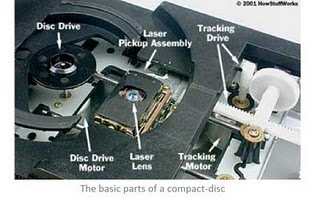
Removable memory planet : The basic parts of a compact disc


Following me next on Removable memory planet!!!!!

Friday, May 6, 2011

Removable Memory Planet : Four types of magnetic storage devices in removable memory planet

There are four types of magnetic storage devices in removable memory planet


1. Magnetic storage disk


First type of magnetic storage devices in removable memory planet is magnetic storage disk, a disk is made of a thin piece of plastic coated with magnetic material on both sides. The tracks are arranged in concentric rings so the software can jump from "file 1" to "file 19" without having to fast forward through files 2 through 18. The disk spins like a record and the heads move to the correct track, providing what is known as direct-access.

Removable memory planet : Magnetic storage disk

2. Zip

Second type of magnetic storage devices in removable memory planet is Zip, for many years, magnetic technology has improved greatly because of the low cost of floppy disks and the immense popularity. One alternative that has become very popular is the zip. The main thing that separates a Zip disk from a floppy disk is the magnetic coating used. On a Zip disk, the coating has higher quality. The higher-quality coating allows the read/write head of the Zip drive to be smaller than on a floppy disk (by a factor of 10 or so). Zip drives use a variable number of sectors per track to make the best use of disk space. All of these features combine to create a Zip disk that can hold a huge amount of data (up to 750 MB).


Removable memory planet : Zip drive


3. Cartridge

Third type of magnetic storage devices in removable memory planet is Cartridge. Another memtod of using magnetic technology for removable memory is taking a hard disk and putting it in a self-contained case. One of successful products using this method is the Iomega Jaz. Each Jaz catridge is basically a hard disk, with several platters, contained in a hard, plastic case. The cartridge contains neither the heads nor the motor for spinning the disk.

Removable memory planet : Current jaz drive uses 2-GB cartridge


4. Portable drive

Last type of magnetic storage devices in removable memory planet is Portable drive. Completely external, portable hard drives are becoming popular, due to the USB technology. These units, like the ones inside a typical PC, have the drive mechanism and the media all in one. The drive connects to the PC via USB cable and, after the driver software is installed the first time, is automatically listed by Windows as an available drive.

Removable memory planet : 20-GB Pocket Drive


Another type of portable hard drive is called a micro drive. These tiny hard drives are built into a card called PCMCIA card that can be plugged into any device with PCMCIA slot, such as a laptop computer.

Removable memory planet : Micro drive which can hold 340-MB


Following me next on Removable memory planet!!!!!